Automation · Workflow guide
AI receptionist vs human receptionist vs call centre: what’s right for your clinic?
Compare AI receptionists, human receptionists and call centres for clinics and hospitals: availability, cost pattern, safety and what each should handle.
Updated
The short answer
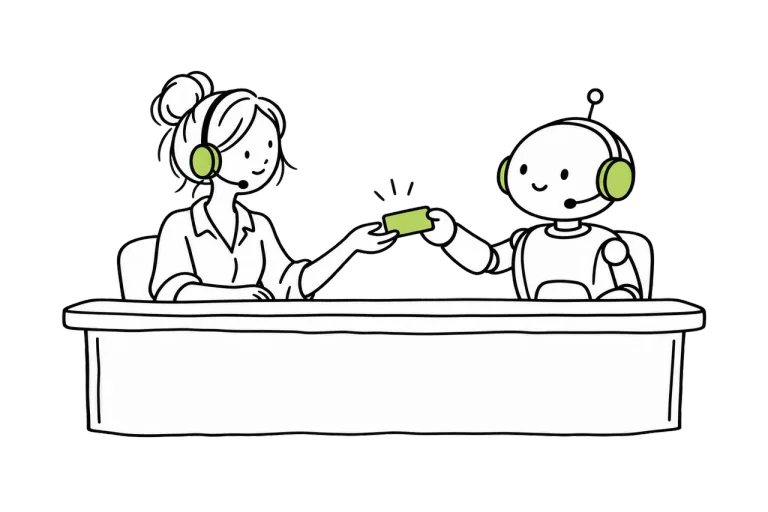
Most clinics need both people and automation. Human receptionists handle patients at the desk, judgement calls and anything clinical or sensitive. An AI receptionist answers every routine call instantly, at peak hours and after hours, and passes complex conversations to staff with context. Call centres add overflow capacity but rarely know your live schedule. Use AI for volume and availability, and people for care and exceptions.
The three options side by side
Each option is strong in different places.
| Human receptionist | Call centre | AI receptionist | |
|---|---|---|---|
| Availability | Clinic hours, one call at a time | Extended hours, depending on contract | Every call, any hour, several at once |
| Knows your live schedule | Yes | Rarely | Yes, when connected to it |
| Patients at the desk | Yes | No | No |
| Clinical or urgent matters | Escalates using clinic process | Escalates using a script | Must hand over to staff immediately |
| Cost pattern | Salary, training and leave cover | Per minute or per seat | Subscription |
| Consistency | Varies with workload | Varies by agent | Same answer every time, as configured |
What an AI receptionist does well
It is best at high-volume, repetitive conversations that follow your rules.
- Answering timings, location, fees, doctors and services
- Offering available slots and recording bookings or booking requests
- Answering when the desk is busy, during lunch and after hours
- Handling several calls at the same time
- Passing a summary to staff when a person is needed
What an AI receptionist should not do
Set these boundaries before switching it on, and test them.
- Give medical advice, interpret symptoms or suggest treatment
- Decide whether something is an emergency instead of directing the caller to emergency help
- Discuss test results or sensitive information
- Confirm a booking that the schedule or staff have not confirmed
- Keep a caller talking when they ask for a person
Where human receptionists are irreplaceable
Reception is also care. Staff greet patients, calm anxious relatives, handle billing questions, notice when someone is unwell in the waiting area and make judgement calls that rules cannot cover. Automation should remove repetitive phone work so they have more time for this, not replace it.
When a call centre makes sense
Call centres suit hospitals with very high call volumes that need human agents across many departments. The common weakness is distance from the clinic: agents often cannot see live availability, so they take messages instead of booking. If you use one, connect it to the same schedule and handoff process as everyone else.
The hybrid model most clinics use
A simple split works well.
- The AI receptionist answers every call and handles routine questions and bookings
- Anything clinical, urgent, sensitive or unusual is passed to staff with a summary
- Reception staff focus on patients at the desk and on handoffs
- The team reviews handed-over calls each week and updates what the AI can answer
Questions to ask before choosing an AI receptionist
Ask vendors to show, not just tell.
- Does it book into my live schedule, and how does it show requests that still need confirmation?
- How does it hand over to staff, and what context does staff see?
- How does it handle emergencies and clinical questions?
- Which languages does it support, and can I test it with my patients’ languages?
- Does it tell callers they are speaking with an automated assistant and offer a person?
- Who can access call recordings and transcripts, and how long are they kept?
Frequently asked questions
Will patients accept an AI receptionist?
Patients mostly want a quick answer and a confirmed time. Be open that it is an automated assistant, keep conversations short and always offer a way to reach a person.
Can an AI receptionist speak Hindi or regional languages?
It depends on the system. Test it with real calls in the languages your patients use before rolling it out.
Is an AI receptionist safe for medical clinics?
It can be, when it is limited to administrative tasks, never gives medical advice, directs emergencies to the right help and hands clinical questions to staff. Test those boundaries before going live.
Does an AI receptionist replace my front-desk staff?
No. It takes repetitive calls off the desk. Staff remain responsible for patients in the clinic, clinical and sensitive matters, and exceptions.